what kind of action does it take to command familiars pathfinder
DnD 5e Familiar Guide
By Jake Morley • Updated: 12/10/21 •
There is a classic trope of spellcasters having some sort of fauna companion, from a witch's black cat to a wizard's owl. Stemming from a long history in European folklore, this idea of an animal servant – or, more than correctly, a retainer masquerading every bit an animal – has been engrained in popular culture in full general and in fantasy (and fantasy RPG's) in item.
So, permit's accept a closer look at this idea of spellcaster'due south niggling sidekicks – what they tin can and can't exist, and tin and can't exercise. Here is a DnD 5e familiar guide.

Familiars in Mythology
The basic notion of familiars extends back into the ancient era – Greeks spoke of daimons, or personal spirits that aided them. Romans had like beings in their households (the word "familiar", in fact, probable comes from the Latin famulus, or "servant"). And an 11th Century Standard arabic text translated into Latin makes explicit mention of someone having a familiar.
In these early depictions, familiars were spirits that were sometimes in the form of an animal, though in a number of cases they might look like tiny humans or stranger, arcane creatures. These forms were also rarely fixed, allowing the familiar to alter frequently.
Commonly assumed to be either demons (in the case of witches) or fairies (in the case of more than benign practitioners), familiars were often credited with teaching their masters magic or other secrets or detecting and diagnosing medical problems. They also, of course, could be used as spies or sentries.
Typical creature forms included the cat, the hare, and the dog, simply fauna forms from a butterfly to a tiny (apparently cat-sized) horse too appear in the accounts. In some cases, they could take on not simply a human appearance, but come with a proper name and a unique identity as well (e.g., "Tom Reid from Scotland").
Familiars in these stories were rarely summoned. Usually, they were encountered seemingly at random, though in some cases the familiar merely appeared and introduced itself at the person's time of need. In a few cases, familiars might be inherited from a relative or acquaintance.
Discover Familiar Spell Earlier Editions
Find Familiar has evolved a skilful scrap from 1st Edition D&D. That version'southward find familiar spell could only be cast in one case per yr and had about a 25% chance of producing nothing at all! The wizard had no control over what they received if they did go a familiar, though the options were similar to function of the listing of familiars in 5E: cat, crow, hawk, owl, toad, or weasel.
One interesting item of this version was the pocket-sized chance that the wizard could get a special familiar on a 5% chance (a roll of exactly fifteen on the die). This could give the wizard an imp, pseudodragon, brownie, or quasit (basically the modern list for warlocks in 5E, if you substitute the sprite for the brownie).
Afterward editions of D&D tweaked the concept of familiars in diverse means – some meliorate, some worse. Some editions dropped the spell entirely and replaced information technology with a Summon Familiar ability.
5E Find Familiar
In 5E, the Observe Familiar spell is a picayune more reasonable – a ritual spell taking an hour, it doesn't have the original limits (or whatsoever limits) on how often it can be cast. And dissimilar in some earlier versions, you select the specific form your companion takes in 5E, from a list of "bat, true cat, crab, frog (toad), hawk, lizard, octopus, owl, poisonous snake, fish (quipper), rat, raven, sea horse, spider, or weasel".
This called grade isn't an actual creature – rather, a familiar is a fey, fiend, or angelic spirit shaped into this likeness to be your servant (though it volition have the regular stats of its form). Note that you lot tin can but have i familiar at a time, all the same – but casting the spell a second time lets you change your familiar's chosen form, a potentially useful power for specific situations when yous have the time to cast the spell.
This familiar, once summoned, acts on its own though information technology obeys all your commands. Inside 100 ft, you tin can communicate with it telepathically and use its senses when y'all choose (though this leaves y'all blind and deafened in your own body). This makes familiars excellent scouts, particularly given the precipitous senses of some of the potential forms.
How to Use Your Familiar
Familiars cannot attack. They tin, nonetheless, practise any number of other actions – most notably a Help activity to give allies reward. They can too search areas or utilize items to the best of their power, too equally use any of their chosen fauna class's non-combat abilities (such every bit the Camouflage ability of the octopus).
This makes familiars a potentially very useful extra set of easily (or paws), able to rummage your pack for a particular item, retrieve something from beyond the room (if they can carry it), operate levers or other elementary controls, and just nearly annihilation else you could reasonably permit a creature in that class to practice. Call up, it's non an beast – information technology'south a spirit-creature of some kind, and more intelligent than a normal cat or bird, so don't be fooled past those natural limitations.
Maximizing Your Familiar
Ane of the best uses of familiars, however, may be in spellcasting. A wizard can apply their action to bandage a "affect" spell and effectively store information technology in their familiar, using the familiar's reaction to evangelize the spell to a target they can't (or are unwilling) to reach themselves. In other words, a magician could cast shocking grasp confronting an enemy across the room, if his rat familiar got close enough to bear upon them (though of course this allows an attack of opportunity confronting the familiar).
Wizards can "store" their familiar safely in a pocket dimension by spending an action. It remains here until the sorcerer brings it back with another action (it will appear within xxx feet of the wizard). They tin likewise permanently dismiss their familiar, requiring a 2d casting of the spell to summon a new one.

DnD 5e Familiar List Ranked
Below is a clarification of the 5E familiar stats for familiars from the default list for the Find Familiar Wizard spell.
Top Tier Familiars
Owl – Air-conditioning: 11, HP: 1, Move: five ft / 60 ft Fly, Passive Perception: 13 – This is a great choice. A fast flyer with 120' darkvision and reward on both sight- and hearing-based Perception checks would be reason enough to select an owl, though they have another pull a fast one on that makes them fifty-fifty more highly-seasoned – the flyby. When using the familiar to deliver a touch spell, the owl's power to sweep through without provoking an attack of opportunity makes the owl a top option.
Bat – AC: 12, HP: one, Move: v ft / thirty ft Wing, Passive Perception: xi – Blindsight with a sixty' radius is no joke, and they have advantage on hearing-based Perception checks. Bats are a great option, especially for nocturnal or underground adventures where the darkness plays to their strengths
Hawk – Ac: 13, HP: ane, Motility: 10 ft / 60 ft Fly, Passive Perception: xiv – These are fast flyers with great vision (advantage on sight-based Perception checks). What the bat is to the dark, the hawk is to the solar day – a pretty great flying sentry.
Middle Tier Familiars
Raven – AC: 12, HP: 1, Move: 10 ft / 50 ft Wing, Passive Perception: 13 – A good flyer, the raven'due south mimicry ability has some potential uses, just information technology'southward non a actually convincing trick – only a DC x Wisdom (Insight) curlicue -then information technology's usefulness might be express.
Spider – Air-conditioning: 12, HP: 1, Move: twenty ft / 20 ft Climb, Passive Perception: 10 – There'due south not much to say about the spider. It has Darkvision (thirty ft) and naturally wouldn't have an issue if you come across webs.
Cat – Air-conditioning: 12, HP: 2, Move: forty ft / 30 ft Climb, Passive Perception: xiii – I of the classics from folklore, cats have good speed, climbing ability (the fastest climbers, of the base list), and advantage on smell-based Perception checks, making them a worthwhile option.
Weasel – Air-conditioning: 13, HP: 1, Movement: 30 ft, Passive Perception: thirteen – Weasels take keen senses, with advantage on both smell- and hearing-based Perception checks. A decent option.
Lesser Tier Familiars
Snake – AC: 13, HP: 2, Move: 30 ft / 30ft Swim, Passive Perception: 13 – They have decent speed, both on land and in water, plus Blindsight (but only 10 ft).
Crab – Ac: 11, HP: 2, Move: 20 ft / 20 ft Swim, Passive Perception: 9 – Though their speed is relatively slow, crabs can motility freely underwater, since they don't need to come up for air. And they can live upward to 24 hours out of the h2o, and so long as they keep their gills from drying out, so they're one of the more than versatile options. Blindsight (30 ft) adds to their appeal.
Frog – Ac: x, HP: 1, Motion: xx ft / 20 ft Swim, Passive Perception: 11 – Information technology has Darkvision (xxx ft) and can spring 10 ft horizontally or v ft vertically if you lot find yourself in a situation where that's helpful.
Cadger – AC: 10, HP: 1, Move: twenty ft / twenty ft Climb, Passive Perception: 9 – The climbing can be handy for scouting, and it does have Darkvision (30 ft).
Rat – Ac: 10, HP: 1, Move: xx ft, Passive Perception: 10 – Rats are and so common they'll never get a 2nd wait when yous send them scouting, and with Darkvision (30 ft) and a keen sense of smell (reward on aroma-based perception), they're pretty good at it.
Situational Familiars
Octopus – Air conditioning: 12, HP: 3, Move: 5ft / 30ft Swim, Passive Perception: 12 – if you're headed into an underwater campaign, it makes perfect sense to take your familiar in the form of an octopus. Relatively quick and stealthy creatures (their Camouflage ability gives them advantage on Stealth checks) with the added bonus of Darkvision (30 ft), it's probably the best pick for beneath the waves.
Quipper – Air conditioning: 13, HP: one, Move: 40ft Swim, Passive Perception: eight – A relatively fast swimmer with Darkvision (threescore ft), this isn't a terrible option for underwater adventuring. Depending on how y'all read the rules, the quipper'south Blood Frenzy ability could besides provide advantage on delivering touch spells.
Seahorse – AC: xi, HP: 1, Move: 20ft Swim, Passive Perception: ten – Tiresome with unremarkable senses, unless you need your familiar to infiltrate the Citadel of the Sea Horse Emperor, at that place'south only no skillful reason for this option
Find Familiar 5e Options – Extended
Historically, familiars could exist a range of animals. And though cats, who are on the approved list, were common familiars in folklore then were dogs and hares, who are not. So, what about these, or other possible options for Find Familiar in 5E, such as the raccoon, marmoset, or platypus?
Well, of course you can always consult with your DM nigh a homebrew familiar. Every bit long as an animal has roughly equivalent stats to something on the list (i.e., similar in movement speed, hit points and general abilities), in that location'southward no reason the specific type of beast can't exist switched out for flavor purposes. A few likely creatures are below:
Badger – Air-conditioning: 10, HP: 3, Move: xx ft / 5 ft Burrow, Passive Perception: eleven – Advantage on odour-based Perception checks, a burrowing motion and 30' Darkvision make this an interesting alternative.
Dog (Tiny) – AC: 12, HP: 2, Move: 40 ft, Passive Perception: 13 – Basically a small terrier version, as near larger dog species run exterior the parameters for familiars, this has proficient speed, reward on smell-based Perception and the potential for "Toto" jokes in your campaign.
Rabbit – AC: 11, HP: 1, Motility: 35 ft / 5 ft Burrow, Passive Perception: 13 – A fast runner who can burrow, rabbits also get advantage on hearing-based Perception.
Otter – Ac: thirteen, HP: 2, Move: 30 ft / thirty ft Swim, Passive Perception: 13 – Dissimilar the weasel, information technology tin can swim well. Too unlike the weasel, information technology doesn't get advantage on Perception checks.
Platypus – Air-conditioning: 11, HP: ane, Move: ten ft / 40 ft Swim, Passive Perception: 11 – A platypus has 30' Blindsight due to electrolocation, though it only works underwater and only detects animals (it senses the nervus impulses running their muscles every bit a way of finding prey).
There are likewise several weird alternative familiars to be found in various books. The almiraj or the flying monkey (Tomb of Annihilation), the tressym (Storm King's Thunder), and the abyssal chicken (Descent into Avernus) are all official alternating familiars, as well as the more conventional hare and trick (Icewind Dale: Rime of the Frostmaiden), though you should nevertheless consult with your DM before trying to summon 1.
The Monster Transmission and Volo'southward Guide to Monsters also lists a set of alternate familiars, including the crawling claw and gazer, though these are meant as options for NPC's, and seem out of balance in terms of power and ability with the standard options. The Anvilwrought Raptor, from Mythic Odyssey of Theros is another such option.
And lastly, notation that "Sorcerer" familiars aren't solely for wizards. The Eldritch Knight bracket can take Find Familiar as one of the Wizard spells it collects at 3rd level, and the Arcane Trickster subclass can practice the same. While the utility of a small animal companion to a knight can exist questionable, there are any number of scenarios in which having a rat, weasel, raven, or the like equally a second gear up of eyes could be useful to a rogue (the Help action, alone, would be useful in giving the rogue perpetual sneak assail damage).
Warlock Familiars: The Pact of the Chain
In vth Edition D&D, familiars are not but limited to the Wizard spell. Warlocks, if they have the Pact of the Chain boon at 3rd level, larn their own version of the Notice Familiar spell – though there are some primal differences.
Warlock familiars practice not have the form of garden-variety animals. Rather, the options come from a small range of magical creatures – the imp, pseudodragon, quasit, and sprite.
Secondly – and perhaps more critically – a warlock's familiar tin make an attack under the right circumstances. The warlock must sacrifice one of their own attacks in the same round for the familiar to attack with its reaction, just that'due south still a big upgrade over a wizard's familiar.
Like wizards, warlocks can use their familiars every bit vessels for casting touch spells – though unlike wizards, warlocks have no such spells that can exercise damage. In other respects – i.e., not-combat deportment, etc., warlock familiars operate under the aforementioned rules as those of wizards.
Warlock Familiars: The Core Listing
Warlock familiars do, however, tend to have more than impressive abilities. A comparing of the stats of these familiars shows even the weakest of them has magical abilities that could be an asset in a number of situations in and out of gainsay, even leaving aside their ability to attack:
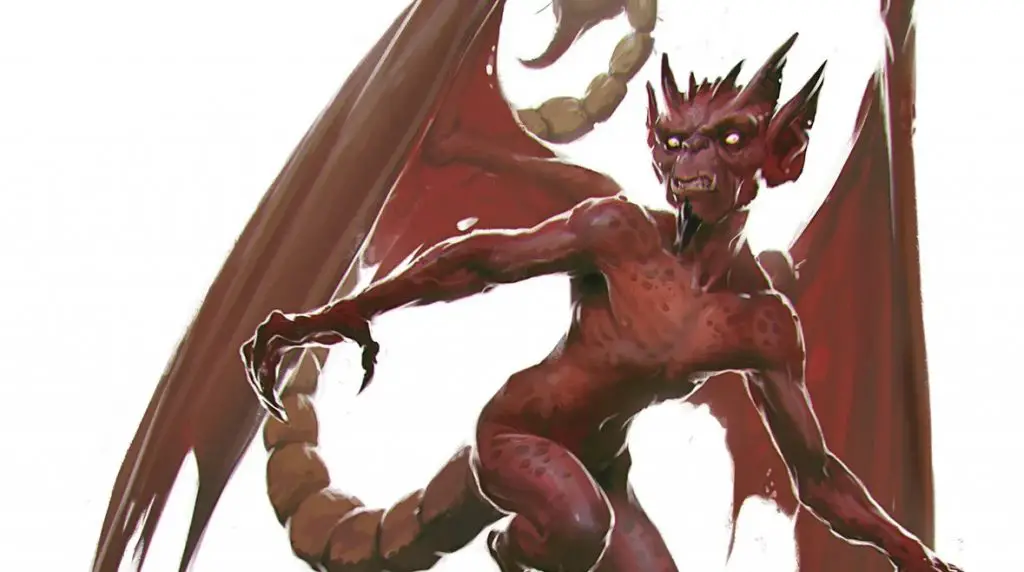
Imp – AC: xiii, HP ten, Move: twenty ft / twoscore ft Wing, Passive Perception: 11 – With advantage on saving throws versus spells and other magical effects, the power to turn invisible, Darkvision up to 120', and last but not to the lowest degree a Polymorph ability that can brand information technology a Swiss Army Pocketknife of the regular wizard familiar options (and more than), it's hard to contend for a better option than this one.
Pseudodragon – Air conditioning: 13, HP seven, Move: 15 ft / 60 ft Wing, Passive Perception: 13 – The pseudodragon has the same magic resistance as the imp, in addition to advantage on sight-, hearing-, or smell-based Perception checks, ten ft Blindsight and 60 ft Darkvision. It as well has limited telepathy with creatures within 100' (other than its master, of grade).
Sprite – AC: 15, HP ii, Move: 10 ft / xl ft Wing, Passive Perception: xiii – The best AC, but the everyman hit points of any of the warlock's options make this perchance the weakest choice – though information technology does take a ranged assault with its bow, can discern emotions and even alignments with its Heart Sight power and can turn invisible.
Quasit – Air-conditioning: 13, HP 7, Move: xl ft, Passive Perception: 10 – This beast has Invisibility and 120' Darkvision like the imp, and can Polymorph as well. Slightly weaker in combat beyond that, it does have a Scare power that tin can be quite useful.
Warlock Familiars: Beyond the Basics
As with wizards, in that location is always a possibility for a homebrew substitution for the warlock's core list. This is a particularly good way to add together season by aligning the familiar type with the warlock's patron (for case, a gazer for a warlock of the Peachy Onetime One).
The bones dominion would be something small- or tiny-sized and not of the humanoid type. They should have generally about fifteen hp, a typical CR of 1, and non be able to cast spells of their ain. Some ideas for alternate warlock familiars for 5E would include the following, though as always with homebrew options, the DM has the final say:
Crawling Claw – Air-conditioning: 12, HP: 2, Move: 20 ft / twenty ft Climb, Passive Perception: 10 – Non the strongest option (and with just 30' Blindsight), only a perfect fit for a warlock of the Undying.
Flying Sword – AC: 17 HP: 17, Move: 0 ft / 50 ft Fly (and can hover), Passive Perception: vii – Based on AC and HP, this seems a tad overpowered for a familiar, though it's obviously express in its deportment with no bodily limbs of any kind and blind beyond its 60' Blindsight radius.
Oblex Spawn – AC: 13, HP: 18, Move: twenty ft, Passive Perception: 12 – The Oblex Spawn has sixty' Blindsight, though information technology can't sense annihilation across that. It tin, however, move through incredibly tight spaces and is immune to a number of conditions included blinded, exhausted, and charmed. It is, however, vulnerable to fire.
Twig Blight – Air conditioning: 13, HP: four, Move: 20 ft, Passive Perception: 9 – Boring and completely bullheaded across its 60' Blindsight, the twig blight at to the lowest degree has the advantage of being indistinguishable from a dead plant when standing nevertheless.
Enjoy Your 5e Familiars!
The official rules on familiars offer a fair amount of specificity, while still leaving enough greyness areas to let you think outside of the box. Can your weasel familiar pour a healing potion down a fallen marry'due south throat if you tell it to? Why not? Can a warlock'due south imp actuate a wand? That'southward trickier.
But even without a lot of debate, familiars potentially have a lot of uses for spellcasters in and out of combat. And used creatively, they can add quite a bit of flavour to the game.
FAQ's
How Long Does Find Familiar Terminal?
Thankfully, your familiar will last but about forever, or until they go killed which means they will temporarily disappear until you resummon them.
Source: https://thedungeonrats.com/dnd-5e-familiar-guide/
0 Response to "what kind of action does it take to command familiars pathfinder"
Post a Comment